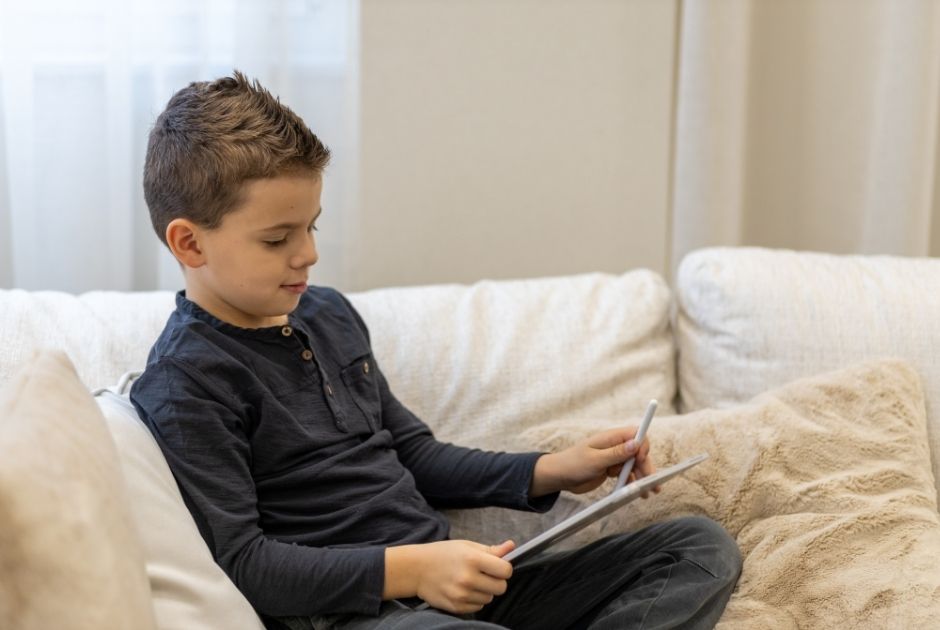
“They hear the iPad perfectly, so I know their hearing is fine.”
It sounds logical.
Your child can hear their favorite show. They immediately recognize the opening music of a game. They hear a video playing and come running from across the room.
So how could there possibly be a hearing problem?
The answer is that hearing a tablet or smartphone is very different from understanding speech in everyday life.
Electronic devices are often close to the listener. Their sound is direct, predictable, and adjustable. Children can also increase the volume or position themselves exactly where the sound is easiest to hear.
Real-world communication is much more complicated.
A teacher speaking across a classroom, a parent calling from another room, or several children talking simultaneously at a birthday party places completely different demands on a child’s auditory system.
Being able to hear an iPad does not necessarily tell you how well a child hears in those situations.
Hearing Something Is Different From Understanding Speech
One of the biggest misconceptions about childhood hearing loss is that a child with hearing difficulty would not respond to sound at all.
Hearing does not work that way.
A child may hear some frequencies better than others. They may hear louder sounds while struggling with softer speech. They may understand conversation perfectly in quiet but have difficulty when competing noise is present.
There is also a difference between detecting sound and clearly understanding spoken language.
Your child may easily recognize that a video is playing without necessarily having equal access to every speech sound during a classroom discussion.
That is why simply observing whether a child responds to loud or familiar sounds cannot replace a professional hearing evaluation.
Why Tablets and Phones Are Easier to Hear
Think about how children typically use an iPad or smartphone.
The device may be only a foot or two away.
The speaker is directed toward them.
The volume may be relatively high.
There are visual cues on the screen.
The content may be familiar.
They are often concentrating directly on it.
Now compare that with a classroom.
The teacher may be many feet away.
Other students are moving and talking.
Air conditioning is running.
Chairs scrape across the floor.
Someone drops a pencil.
The teacher turns toward the board while continuing to speak.
Those are dramatically different listening environments.
A child who performs well when sound is close and controlled may still have difficulty when speech becomes softer, more distant, or mixed with background noise.
Distance Changes the Listening Challenge
The farther a child is from a speaker, the more difficult listening can become.
This is why a parent might say, “They hear me perfectly when I’m next to them, but they never respond when I call from the kitchen.”
It is tempting to assume the child is ignoring you.
Sometimes they are.
But distance reduces the level of the speaker’s voice reaching the listener, while environmental noise may remain present.
For a child with hearing difficulty, that difference can make speech much harder to access.
Patterns matter.
If your child consistently hears better when you are close, it may be worth investigating why.
Background Noise Can Reveal Hearing Difficulties
Noise is another major difference between screen time and real-world listening.
Children spend much of their day in environments that are far from quiet.
Classrooms have multiple students.
Cafeterias are loud.
Playgrounds are noisy.
Family dinners may involve several people talking simultaneously.
In those environments, the auditory system has to separate the important voice from competing sounds.
A child may appear to hear normally during a quiet conversation at home but struggle significantly once background noise is added.
That is one reason hearing concerns may become more obvious at school than they are at home.
Visual Cues Can Hide Listening Difficulties
Screens also provide a huge amount of visual information.
A child watching a familiar cartoon does not have to rely entirely on hearing to understand what is happening.
They can see characters, actions, expressions, captions, menus, icons, and other contextual clues.
Children can use similar strategies during face-to-face communication.
They may watch your lips or facial expressions closely without consciously realizing they are doing it.
If they understand better when looking directly at you but struggle when you turn away, that pattern is worth noticing.
Signs Your Child May Need a Hearing Evaluation
Parents should look at overall communication patterns rather than one example of successful listening.
Possible signs of hearing difficulty can include:
- Frequently asking “What?”
- Not responding consistently to their name
- Hearing better when the speaker is nearby
- Increasing device or television volume
- Difficulty following verbal directions
- Watching people’s faces closely when they speak
- Struggling more in noisy environments
- Seeming distracted during spoken instruction
- Misunderstanding words
- Speech or language concerns
- Teacher concerns about listening or attention
- A history of frequent ear infections
These signs can have many different causes.
The purpose of hearing testing is not to assume hearing loss. It is to determine whether hearing is part of the picture.
Why Classroom Hearing Matters So Much
A child’s ability to learn depends heavily on access to spoken information.
Teachers explain new concepts verbally.
Classmates answer questions.
Instructions may be given while the teacher walks around the room.
Children are expected to follow discussions, remember verbal directions, and learn new vocabulary throughout the day.
Missing small pieces of speech can add up.
A child may compensate by watching classmates or guessing from context, but that requires additional effort.
Before assuming a child is inattentive, unmotivated, or simply “not listening,” it can be helpful to make sure the auditory information is reaching them clearly.
“But They Passed Their Last Hearing Screening”
A previous hearing screening is valuable information, but hearing status can change.
Middle ear fluid, ear infections, certain medical conditions, noise exposure, and other factors can affect hearing after a previous screening.
Screenings are also designed to identify potential concerns rather than answer every possible question about how a child processes sound in everyday environments.
If parents, teachers, or healthcare professionals continue to have concerns despite a previous screening, further evaluation may still be appropriate.
What Happens During a Pediatric Hearing Test?
Hearing testing for children can be adapted based on age and developmental ability.
Depending on the child, testing may involve listening games, responses to tones or speech, middle ear measurements, or other age-appropriate techniques.
The goal is to gather objective information about how the auditory system is functioning.
Parents do not need to figure out at home whether their child “really” has a hearing problem.
That is exactly what professional testing is designed to help determine.
Frequently Asked Questions
Can a child hear some sounds normally and still have hearing loss?
Yes. Hearing loss can affect different frequencies or ears differently. A child may respond well to certain sounds while having difficulty with others.
If my child hears the TV, does that mean their hearing is normal?
Not necessarily. Television and devices may be louder, closer, and supported by visual information. They do not recreate the listening demands of classrooms and everyday conversation.
Why does my child hear me nearby but not from another room?
Distance makes speech softer by the time it reaches the listener. Background noise and room acoustics can make distant speech even more difficult to understand.
Can hearing problems look like attention problems?
Sometimes. A child who cannot clearly hear instructions may appear distracted, fail to follow directions, or watch classmates to determine what they should be doing.
When should I have my child’s hearing tested?
Consider discussing hearing testing with an appropriate professional if you notice inconsistent responses, frequent requests for repetition, speech or language concerns, difficulty in noise, teacher concerns, recurrent ear infections, or other changes in listening behavior.
Do Not Use the iPad as a Hearing Test
Your child’s ability to hear their favorite video is reassuring in one very specific situation.
It does not tell you everything about their hearing.
Real life happens across rooms.
It happens in classrooms.
It happens while several people are talking.
It happens with soft voices, unfamiliar words, background noise, and speakers who are not always directly in front of your child.
Those are the listening situations that matter for communication and learning.
If something about your child’s responses, speech, classroom performance, or listening behavior does not seem right, do not let “but they hear the iPad” be the reason you dismiss it.
A pediatric hearing evaluation can provide a much clearer picture of how your child actually hears the world around them.